Maisu Log '26: Funeral Before Setting Sail, May 11
 Wind Voyagers of Changbin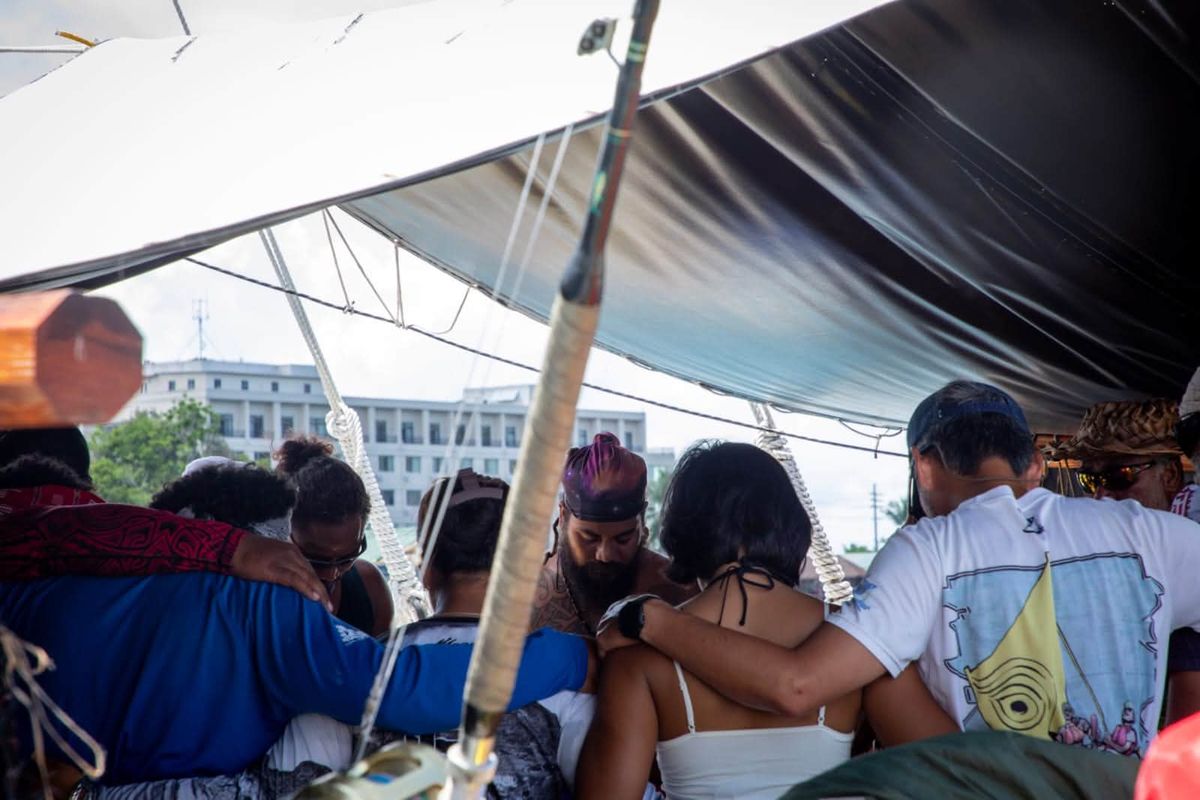
Original version in Chinese
✐ Isin (Guanyuu) ✐
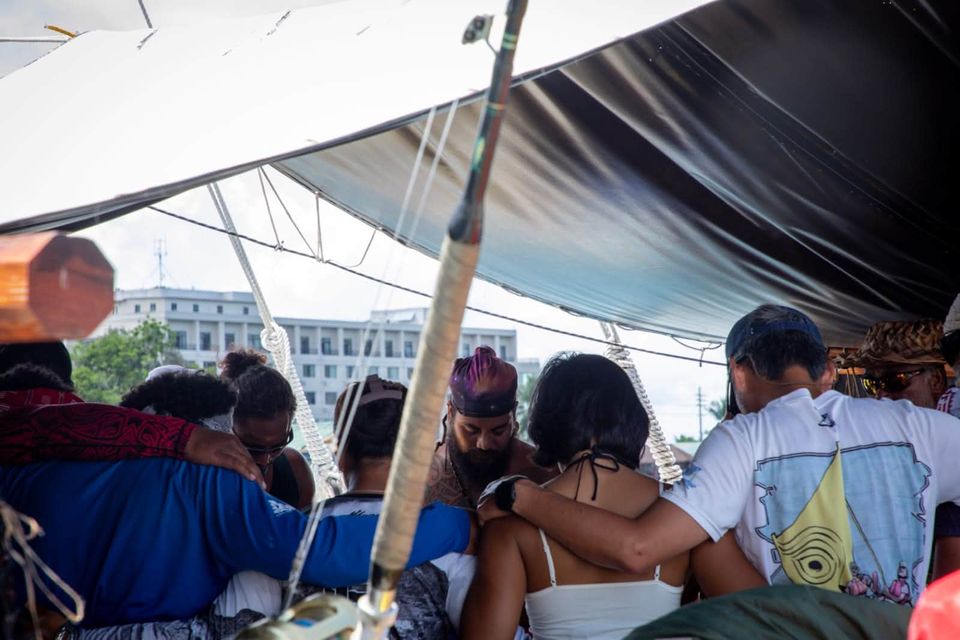
The Alingano Maisu came alongside the pier in Palau on her port side. Captain Sesario asked us all to stay on board and gather on deck near the rudder. All fifteen of us formed a circle. At first, we simply held hands, but almost instinctively, we shifted to putting our arms over each other’s shoulders, leaning in close. Sesario asked Wayne, the eldest among us, to lead a prayer. Wayne began to recite: “Heavenly Father, thank you for bringing…”
His prayer suddenly broke off as Wayne burst into uncontrollable tears. In the silence that followed, tears welled up in my own eyes; I understood completely why Wayne was crying. Many others were weeping too, everyone trying desperately to hold back their sobs.
During the latter part of this voyage, as typhoons formed one after another, we had to abandon our original destination of Guam to seek shelter. We initially aimed for Yap, but after a few days, we realized we couldn’t make it in time. We had no choice but to head for Palau to return to Maisu’s home port, extending our voyage by nearly 500 kilometers. To make matters worse, a third typhoon caught up with us off the northeastern coast of Palau, trapping us in a fierce struggle against the storm for two full days and nights.
Throughout the storm, strong winds blew relentlessly from Palau—straight from our destination—blocking our way. During my six-hour shifts, I was completely exposed to torrential rain, howling winds, and towering waves. Then came six hours of rest inside a violently tossing cabin, only to crawl back out into the same fierce storm and massive seas.
Whenever the wind eased slightly, we had to raise the appropriate sails to maintain momentum and keep from drifting off course. Yet whenever a violent gust struck out of nowhere, we had barely 20 seconds to drop the sail; a moment’s hesitation could mean losing the mast entirely. Four or five young crew members would rush to the bow, clinging for life amid the terrifying surge of water as they wrestled the sail down. The wild wind not only whipped the tail of the sail violently, but also sent a bone-chilling vibration humming through the mast and upper rigging. We would then wait for the next viable window to hoist the sail once more, repeating this grueling cycle over and over.
Meanwhile, the galley crew still had to keep meals coming, boil water for coffee, and even cook rice! In the rolling seas, pots would fly off the stove, spilling hot water everywhere. Drenched in pouring rain, the cooks pushed through sheer resilience to keep us nourished.
There were countless other ordeals: the constant popping noises as the hull twisted under the pressure of the swells, seawater constantly splashing over us, perpetually soaked clothes, the fear of being swallowed by a wave while going number one and two, and the total impossibility of showering... These relentless conditions wore on us day and night, inflicting immense physical and mental strain. It was almost impossible not to feel afraid. Although the experienced sailors tried to mask it with humor, I could still feel a heavy pressure hanging over us like a black boulder, impossible to cast off.
My mind also drifted back to earlier in the journey, before the storms, when our destination was still Guam. Out in the middle of the endless ocean, a mix of monotony and alcohol had sparked a few crises on board. Thankfully, protected by the spirits, things did not escalate—otherwise, the consequences would have been unimaginable.
All of this serves as a reminder that long-distance ocean voyages are fraught with unforeseen perils. Every trivial matter on land can easily escalate into a crisis at sea.
So, if you have truly lived through a passage like this—unless you are made of stone or stubbornly blind—you cannot escape a sense of absolute awe and reverence for the ocean. You come to realize, from the very core of your being, just how tiny human existence is in the presence of the sea.
That is why we stood in a circle, arms over shoulders, heads bowed, leaning tightly into one another. We all understood Wayne’s tears. We had given everything; we had failed, we had erred, we had endured, we had shared laughter, and we had encouraged, supported, and cared for one another. Most important of all, we were watched over by the spirits. Perhaps that overwhelming gratitude could only be voiced through tears, carrying a meaning far beyond what words could ever convey.
In 1975, the year before Hōkūleʻa embarked on her historic maiden voyage, navigators from the Micronesian island of Satawal completed an extraordinary passage of over 3,500 kilometers from Satawal to Okinawa aboard the traditional sailing canoe Chechemeni. Looking back at a scene from the documentary Chechemeni’s Adventure, before setting sail, the families on the island wept as though attending a funeral; the men about to depart were smeared in turmeric, bowing their heads in solemn, silent grief. That scene left a deep impression on me, though it once baffled people.
From an ordinary perspective, these navigators were setting out to conquer an unprecedented journey in history, full of ambition and courage. Shouldn’t they have been met with cheers and celebration? Why weep for them?
Now, at last, I understand. Had it been me, I would have wept too. They were the ones who truly knew the ocean. They were a true seafaring people.
Many in Taiwan have expressed hopes that our people would embrace the ocean, even boldly declaring that we are a maritime nation. What, then, with what mindset should we prepare ourselves for navigating the open ocean? I offer this journal entry for us all to reflect upon.
Post-edited by Yulun Huang (Yaya)