Maisu Log '26: Squall, May 9
✐ Isin (Guanyuu) ✐
At noon, I crawl out of my bunk, and a strong wind slams straight into my face. Still half-asleep, I am blown wide awake in an instant.
Good lord—when I went to sleep at dawn, everything was peaceful and the breeze was barely blowing. How could the sea and sky turn so ferocious in just a few hours? The outboard engine at the stern growls steadily, working alongside a tautly sheeted foresail as we fight against fierce headwinds out of the southwest. Word has it we are nearing our destination, Palau. We are already in the waters northeast of the main island and cannot be far from its northern atolls, yet the wind stubbornly refuses to let us draw near.
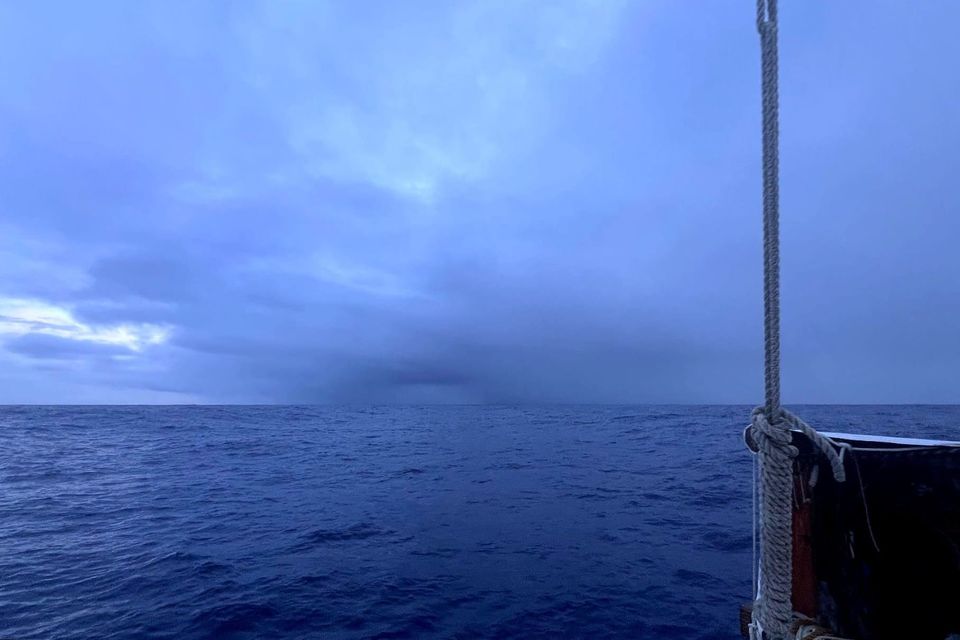
Toward evening, conditions worsen. Scanning the horizon in every direction, the sea is ringed with squall clouds. We can probably ignore those leeward of us, but the ones to windward are bearing down fast. They look like massive, mountain-sized blocks of dark gray cloud, with black mist hanging beneath them. Only that is not mist—it is sheets of heavy rain plunging into the ocean. Behind us, a storm cloud is spreading outward to both sides of the canoe; it is closing the distance, about to swallow us whole.
The crew springs into action, speaking Satawalese mixed with English, and perhaps a bit of Palauan—all far too rapid for me to catch. What is going on?
I find myself in this exact situation constantly on board. Captain Sesario and his most trusted crew communicate in Satawalese, tossing in Palauan when needed. Because most of the crew work in Palau, even those who do not speak it can understand it. English is only mixed in—spoken with a distinctive accent and phrasing—for the benefit of those of us who only speak English. When it gets too fast, I am completely lost. Thus, I am frequently forced to play the “wooden dummy.” All I can do is watch and observe.
I see Captain Sesario leap down from his elevated seat onto the deck, pull out his one-piece rain suit, slip into it swiftly, and zip it tight. Next, he rolls up his sleeping pad and sleeping bag and stows them away.
I pause, read the cues, and this “wooden dummy” finally gets the message. Move fast! I pull out my rain jacket and trousers and hurry to put them on. I quickly tuck the notebook in my hand into a dry bag. Where is my phone? Good, it is already secured inside another waterproof pouch. Okay, time to zip up the jacket. Ah—the zipper slider is corroded blue-green by seawater and completely jammed. Fine, I will fasten the outer snap buttons one by one instead. Should I start from the top or the bottom…
A torrential downpour suddenly hits before I’ve even finished buttoning up! Driven by fierce gusts, cold raindrops hunt down every gap in my rain gear, finding a way to seep inside.
The wind picks up rapidly. The mast, sails, and rigging make weird noises in the howling wind, and every eye locks onto the tall foresail at the bow. Captain Sesario shouts a single command in Satawalese, and several young crewmen surge forward toward the bow. The wind grows increasingly violent. There is barely a twenty-second window; if they fail to douse the sail in time, the mast could actually snap. One crewman sprints to the very tip of the bow, standing on a spot barely two footprints wide, grabs the sail with both hands, and hauls it down with all his strength. Simultaneously, several others work in seamless coordination: one eases the sheet while maintaining just enough tension; another pays out the halyard smoothly to match the descent; others gather and bundle the heavy sailcloth to keep it from spilling into the sea. All of this unfolds amid towering swells, the canoe pitching and rolling violently.
Once the sail is down, everyone waits in place for a bit, watching to see how the weather unfolds. If the wind eases up, the captain might order the sail hoisted once more. If it eases only slightly yet remains dangerous, they might hoist the smallest storm sail instead.
More often than not, however, the wind refuses to relent—it only intensifies, while rain hammers the deck with fury.
At moments like these, the captain again gives a single word, and two or three young Satawalese crewmen step forward. Standing beneath the mast, they raise conch shells to their lips and blow. The tone is deep yet resonant and piercing. Two or three conches of differing pitches ring out together in harmony. Heard across a violently pitching deck in the middle of pouring rain and howling gusts, the sound makes your scalp tingle and the hairs on your arms stand on end.
The conches are blown to calm the wind—to communicate with the sea, as if saying: “Please let go of your anger. Please be still!”
Not long after the conches sound, the wind often dies down. Of course, there are times when the wind remains stubborn and untamed, and there is nothing left to do but endure it.
It was only then that I understood why the conch shells aboard the Maisu rest in plain view, yet no one ever touches them in fair weather. Their sound carries genuine power. Blowing the conch isn’t for fun; it is neither a musical instrument nor a way to show off or draw attention to yourself.
After the squall passes, the rain ceases, though the wind continues blowing straight out of Palau. Our bow points into the wind, and the waves settle slightly.
“One, two, three, four, five,” Edson counts, pointing from left to right across the horizon ahead. “And there are more further to the right.” Each one is a rain-heavy squall cloud rolling toward us
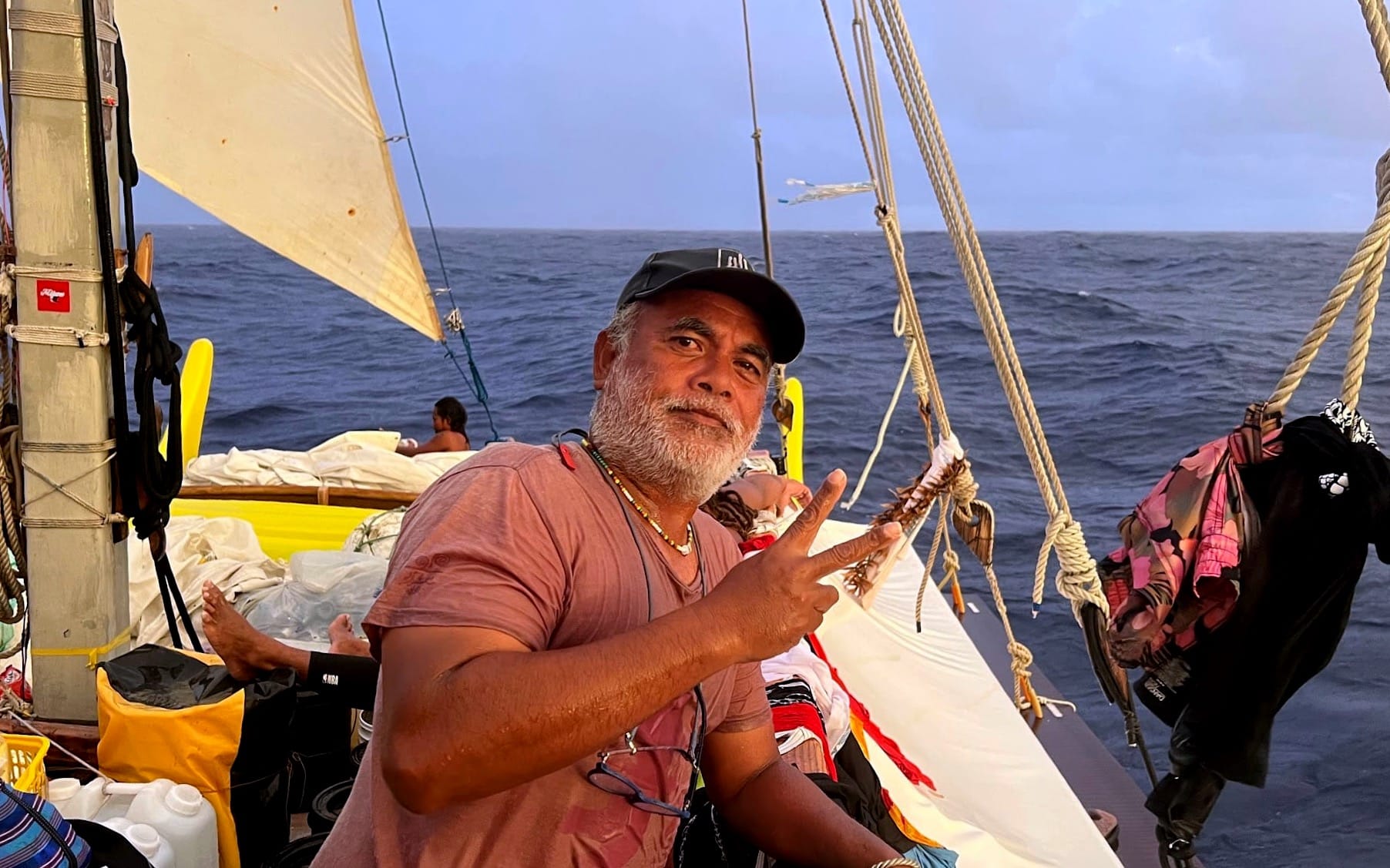
Yet for reasons no one can explain, the clouds to the west scatter within a remarkably short time. Just before nightfall, the ocean often grants a brief window to catch your breath—like halftime in a ball game.
The setting sun breaks through the cloud, bathing the entire sky in endless gradients of gold—a spectacle so vast no camera could ever truly capture its magnificence. Suddenly, we are enveloped in sheer beauty. Everyone falls silent. On watch or off, everyone on deck sits or stands, taking it all in like a slow, magnificent movie.
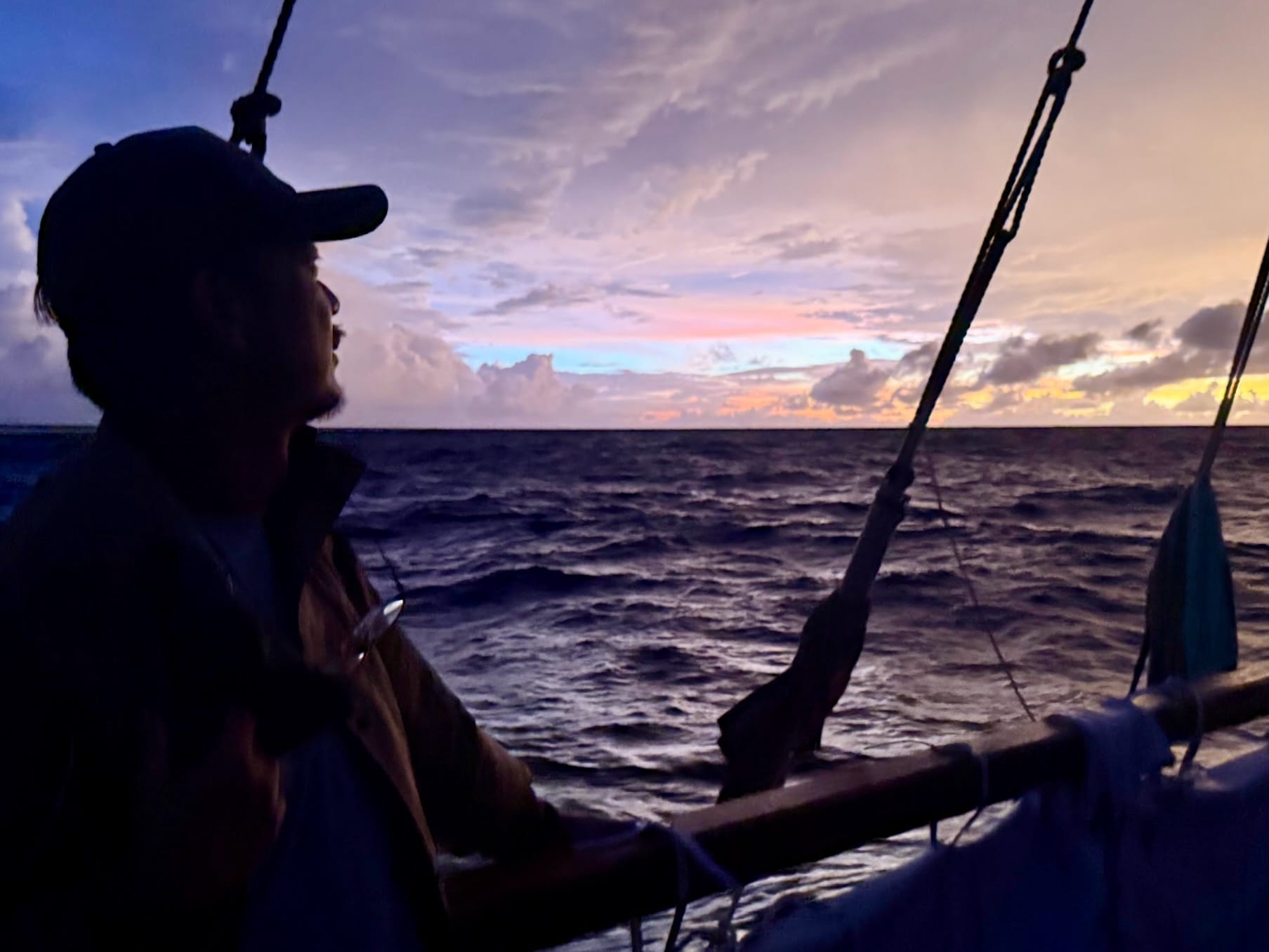
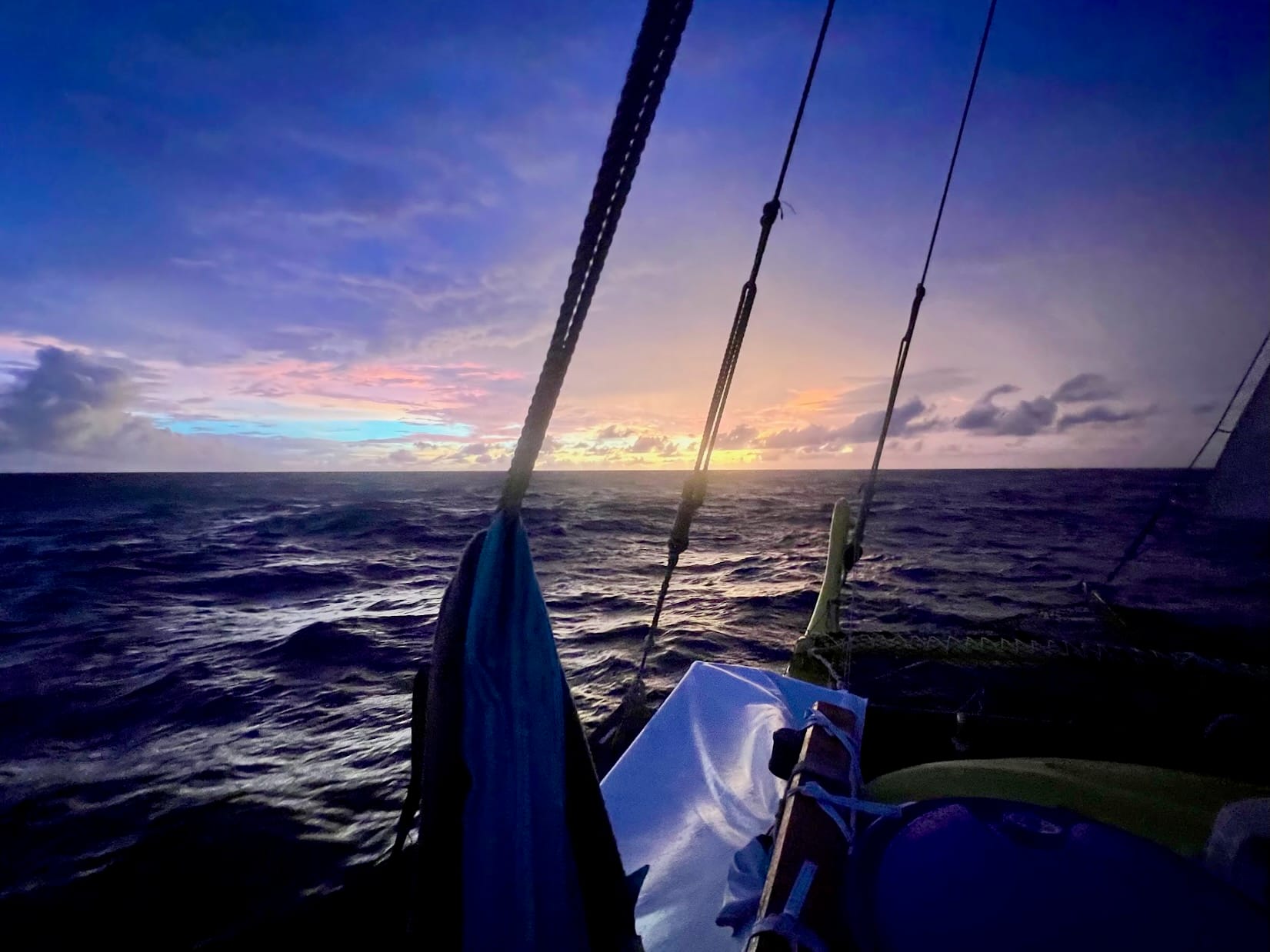
I suddenly recall the seasoned wisdom shared by several navigators: a golden sky at dusk often means a rough night ahead.
My watch has already ended. I fold my rain jacket and trousers, toss them into my bunk, and crawl quickly inside to lie down in my hammock. Sleep comes first. Come midnight, I might have to climb back to face another storm. For now, all I care about is sleep; nothing else matters.
Post-edited by Yulun Huang (Yaya)