Maisu Log '26: Stormy Seas off Miyakojima, April 6
 Wind Voyagers of Changbin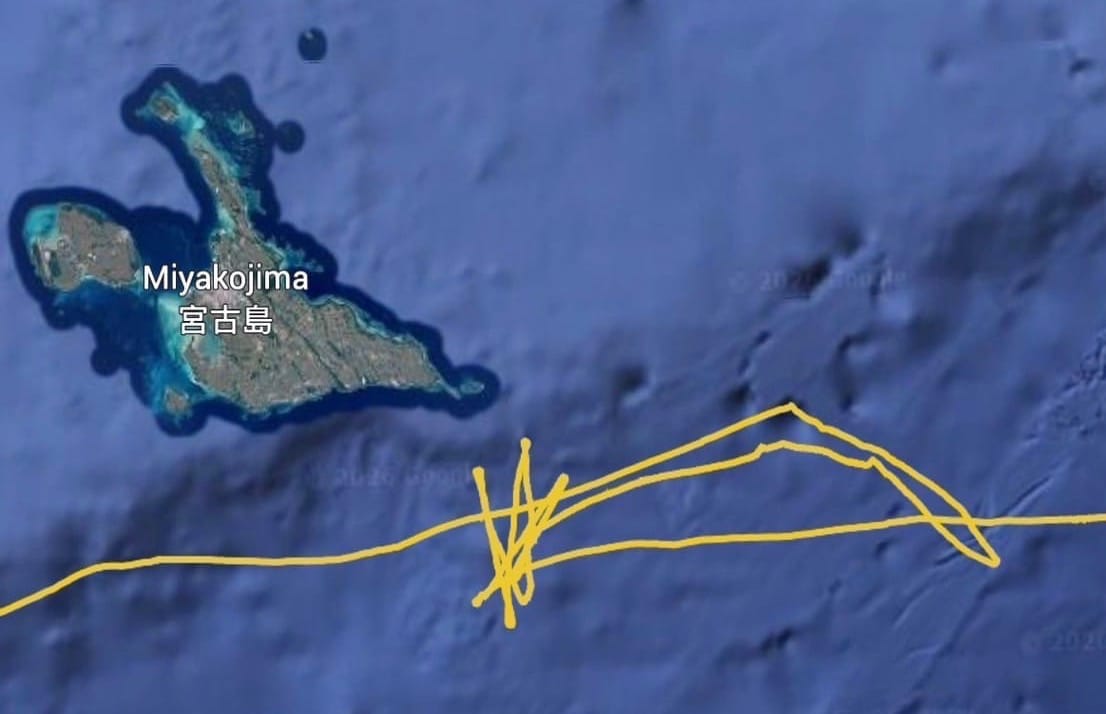
Original version in Chinese
✐ Isin (Guanyuu) ✐
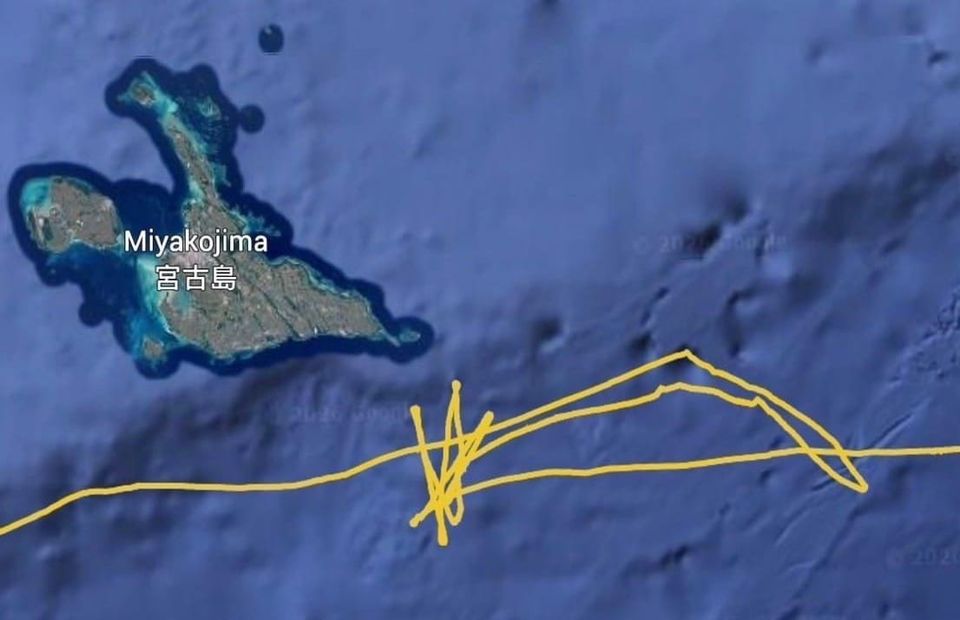
Around 8:00 PM, I was huddled on the elevated bunk at the aft end of the port side cabin. Gale-force winds lashed through gaps in the awning; as soon as I managed to plug one hole, the wind would force its way through another. A 100% darkness enveloped us, stretching from the infinite void to the very edges of the canoe. I began to doubt if light still existed in this world, save for the distant Miyakojima lighthouse. Its white and red beams swept the horizon every few seconds, their rhythmic pulse only deepening the night’s profound gloom. Outside, massive swells heaved the hull skyward, only to let it crash down at the peak of the surge. I gripped the wooden frame tight, praying I wouldn’t be hurled overboard.
The wind grew so fierce that the distinction between watch and rest vanished. The young crew stripped to the waist, standing ready in nothing but shorts. The captain first ordered the mainsail doused to prevent the mast from snapping. Lowering a sail in such a violent storm is no easy feat: one person loosened the halyard, two stood beneath the jib sail to haul it down by force, two more clung to the netting and catwalk to lash the canvas, while another secured the lines. All of this unfolded amidst violent lurching and a constant drenching of sea spray. These Micronesian sailors executed every task with calm precision. Usually, they are full of laughter; tonight, they were solemn.
 Wind Voyagers of Changbin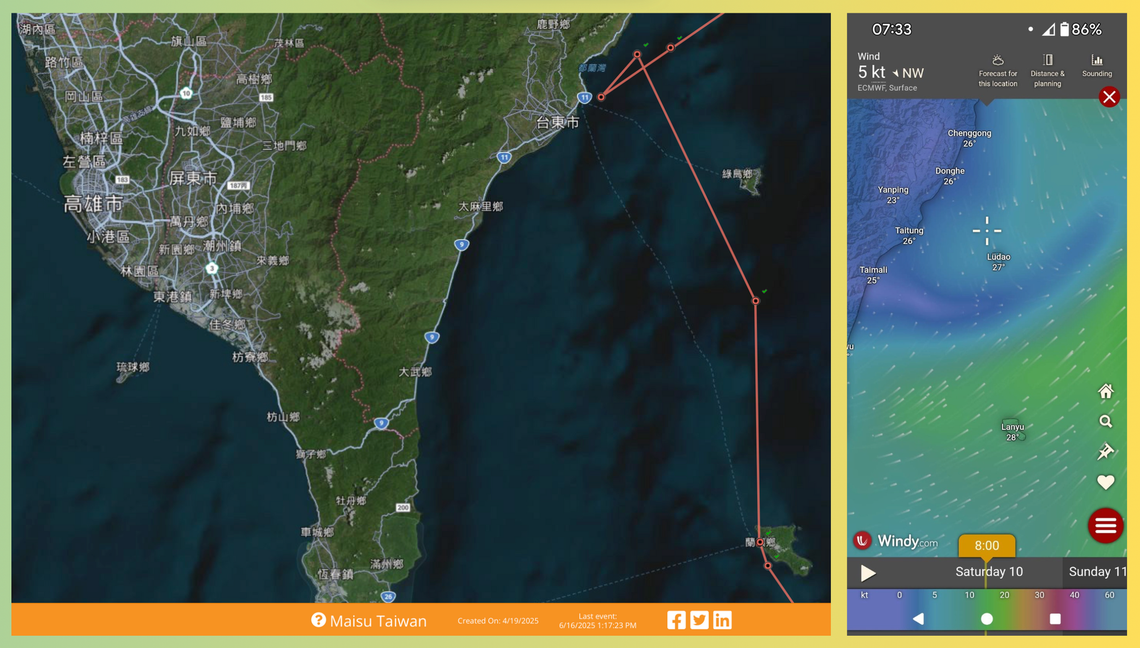
The captain then ordered the storm jib—the smallest sail—to be hoisted to maintain steerage. The crew worked together to raise it in the pitching sea, but as the mast began to twist under the strain, it was immediately lowered. The wind was simply too powerful; we couldn’t risk the mast.
The storm caused the rigging to vibrate with a discordant, whistling shriek. Suddenly, a massive gust slammed into us, shattering the whistling sound and forcing the hull to heel and drift. I suddenly realized—wasn’t this the arrival of a Northeast Monsoon front? I had felt this many times on the east coast of Taiwan, but this was the open ocean version.
If my intuition held, the storm might subside before dawn. The wind would then shift east, and the weather would improve, perhaps bringing 1~2 days of blue skies before turning into a southerly wind for 2~3 days—at least until the next front arrived. But these were mere guesses; only God knows how the elements truly move.
First, however, we had to survive the night.
We started the engine. Four young crew members joined forces to heave the tiller, forcing the steering paddle deep into the water to gain enough leverage to turn. In this gale, the usual steering force was insufficient; we needed the engine’s help. Kazu, an experienced Japanese sailor, kept her eyes glued to the compass, calling out the headings: tan Paiefang, tan Paiyor, tan Tumur... At this moment, the canoe became a world of the Satawal language. Once we successfully turned to the captain’s designated heading, the engine was cut. Most went to rest, leaving only a few to monitor our heading. We began to drift.
I recalled reading Micronesian voyaging records that mentioned lowering all sails to drift during extreme weather. I never imagined that experiencing it firsthand would be so terrifying—this was the vast gulf between knowledge gained from words and the reality of a physical experience.
The storm raged on. I forced myself to close my eyes, but whenever the wind pummeled us, I couldn’t help but pull back the curtain to check the black sea: Was the stern still pointing toward the Miyakojima lighthouse? Were we drifting too close to the island?
All night, Alingano Maisu maintained a safe distance from Miyakojima. Drifting through the darkness, I could still see the lighthouse’s red and white flashes. The captain and this crew clearly knew this vessel and these winds intimately. In the midst of what felt like incomprehensible chaos, they remained composed, resting and waiting with absolute confidence.
I finally fell asleep just before dawn. When I opened my eyes, the sun was up. Miyakojima was still behind us. The swells remained large, but the wind had eased and shifted slightly to the east. The air was thick with salt mist, hiding the sun.
We raised the sails. The captain signaled a heading of tan Mesaruw. It wasn’t until my group took the afternoon watch that we tacked toward tan Mailapaiefang, then switched back to tan Mesaruw on the next watch. We spent two days watching Miyakojima recede and approach, over and over. I prayed for a south wind to carry us toward Okinawa. But for those two days, the northeasterly wind held firm. We moved slightly east, but for the most part, we were treading water.
Two days later, early in the morning, the sun broke through and the wind finally shifted south. We had finally caught the wind of Okinawa! The captain ordered a heading of tan Mailap, and we officially began our crossing of the Miyako Strait. The sky is clear; tonight, we may witness the first full canopy of stars of this journey.
Translation post-edited by Yulun Huang (Yaya)