Maisu Log '25② Onboard Was Not the Original Plan, May 9-10
 Wind Voyagers of Changbin
Original version in Chinese
✐ Yaya ✐
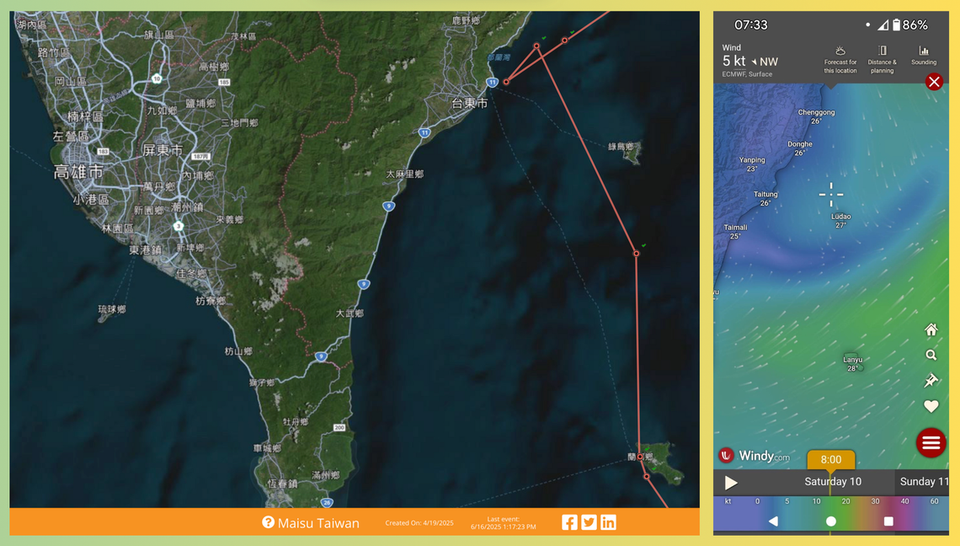
I was invited by Hsiao-hai to help with translation on Lanyu (Pongso no Tao). I arrived in Lanyu on May 7, eventually seeing the crew off from Taitung on May 17. Those ten days were full of new experiences. This story is from my journal about an unplanned adventure: sailing from Lanyu back to Taitung with the crew.
Ngirai turned to me and asked, “So, would you like to come aboard?” My mind went completely blank. He added, “How about this: if you get on the canoe, I’ll get on too.” At that moment, Sesario was sitting right between Ngirai and Hsiao-hai. I gathered my courage and asked, “Cap, can I sail back to Taiwan with you?” Cap agreed. I looked at Hsiao-hai, and he nodded with a smile.
The next day, May 9, was very busy. We had a second welcoming ceremony and cultural exchange in the morning, and visited different communities and significant landmarks in the afternoon. At 5:00 PM, we rushed back to the harbor because the crew had promised some kids a tour of the Maisu. The kids scrambled in and out of the cabins, fascinated by how the crew slept and cooked. Before dinner, I squeezed in time to contact the rental shop (arranging to return the scooter at 10:00 PM) and reached out to my friend Yo at the county government (in case my laptop’s wrapping wasn’t waterproof enough for the ride, I needed him to take it back to Taitung). A-Dong kept giving me a look that said, “Don’t do it—you’ll suffer too much.”
This was our final dinner on Lanyu, arranged by Hsiao-hai at a cozy, casual restaurant. Unlike other exchange events I’ve attended, the atmosphere was unique—warm and grateful, but there was no long, sad goodbye. Perhaps it was because boarding was imminent (we were to gather in 3 hours), or perhaps that’s just the way of the seafarer. As soon as they finished eating, the crew members left one by one to get ready. But Ngirai—he didn’t board! I had been stood up by the Minister!
After dinner, I went back to my room to pack, shower, make a few calls, and check the weather on Windy. I was a nervous wreck—terrified that getting seasick would ruin this rare chance to learn. The medicine Tua suggested (Meclizine) worked like a charm on the way to Lanyu, but I had no idea if it would hold up for the trip back.
A message arrived, saying the meeting time was pushed to 11:00 PM. I dropped off my rental scooter and walked over to the Maisu to leave my bags. Since there was still time, I walked over to the crew’s hotel. I was surprised to find almost everyone ready to go. These young crew members are usually just joking around and acting lighthearted, but when it comes to timing, they are incredibly disciplined. I admired that.
Right at the stroke of midnight between May 9 and 10, we boarded at Kaiyuan Harbor. The Coast Guard called roll according to the list Hsiao-hai had provided. I found a seat on the port side of the mast next to Andrea; having her there really made me feel safe. Lau was there too, and it felt like I had taken over his rookie role. He was so thoughtful, constantly checking in to see if I needed anything. I glanced at my phone—it was almost 12:00 AM. Every crew member was in position, just waiting for Cap’s command.
It wasn’t pitch black yet. I watched Cap’s silhouette at the stern as he looked out toward the open sea. I couldn’t tell if he was feeling the wind, watching the swells, or reading the sky. Between the light pollution and the thin clouds, I couldn’t see a single star. The wait felt like forever. Suddenly, a flash like lightning streaked across the port-side sky. The crew gasped—a meteor! No, it was bigger and brighter than that—a fireball! “It’s a good sign,” Andrea whispered with a smile.
Then, the motor started. Cap gave the order to depart. I checked my phone again—00:10 AM. Only ten minutes had passed. The Maisu backed out of the harbor as the steering team—Moss, Clyde, and Andrew—swung the massive steering paddle in a wide arc to turn us. It was exactly the principle Isin (Guanyuu) had explained to me before.
The Maisu runs on six-hour watches starting at 12:00. Each watch is made up of five people: one at the helm and four on lookout duty, covering the port, port-bow, starboard, and starboard-bow. Night is the most dangerous time to sail, especially when you’re crossing busy shipping lanes—and tonight was exactly that.
Unsurprisingly, dizziness set in before long. I lay down on the deck against a stowed sail, which felt surprisingly soft. Lau kindly covered me with his jacket, and Wayne laid out a sleeping mat next to me, resting on the deck to the starboard front of the mast. I figured everyone else must have rested well on Lanyu, as they all seemed wide awake. Or maybe they just didn’t want to sleep—they wanted to memorize every inch of this sea.
I definitely didn’t want to miss a thing. I heard Ismael walking toward the bow, slowing his footsteps as he got close, clearly trying not to step on Wayne or me. I felt a little guilty for taking up the space. Once he passed us and reached the prow, I tried to figure out who else was up. Andrea was right there by the mast, but I couldn’t tell who was over by the cleats on the starboard rail. I listened to Ismael calling out “wait wait wait” and “go go go,” mixed with Carolinian phrases I couldn’t quite catch. Then, the white sail rose into view on the starboard side. I felt this sudden surge of joy—and a strange, deep sense of security.
When I woke up again, the sky had completely cleared. It was full of stars, and the moon was hanging somewhere off the starboard bow. I checked the time—it was around 3:15 AM. Wayne was wrapped up like a cocoon beside me, sleeping soundly. Andrea was still locked in on her lookout. I followed her gaze and couldn’t believe it—there were so many cargo ships! It was such a surreal sight; I had no idea the sea was this busy at night. The massive ships were lit up like sea monsters having a party while the rest of the world slept. Or, because it was so quiet, they looked like a slow, glowing migration. Andrea was tracking one not far to our port front that was moving toward our starboard front. She told me that Maisu doesn’t show up on the commercial radars, so those big ships might not even know we are there. We had to be very careful to stay out of their way, especially since it’s so easy to misjudge distance and speed in the dark.
The lookout crew kept calling out the positions of the other ships to the stern: ten o’clock, eleven o’clock... The sea breeze felt great, and everything was much quieter. That’s when I realized—the motor was off. It felt wonderful. Moss, worried I’d get cold, brought over his jacket to cover me. Unlike Lau’s lightweight windbreaker, Moss’s black jacket was thick and dry, and it smelled fresh—he must have washed it back on Lanyu. The heavy warmth of it was so comforting that I drifted off again.
I woke up around 4:00 AM, and then again at 5:30 AM. By then, the sun was coming up, and Green Island appeared off our starboard bow. It was close enough that I could make out the buildings on shore. Edson, a curious soul from Saipan, came over to sit by me. Seeing that I was finally awake, he started picking my brain. “What’s on Green Island?” he asked.
The first thing that came to mind was the National Human Rights Museum. I told him it was a place where political prisoners were held during the “White Terror” period. Many of them were intellectuals who actually ended up teaching the local children while they were imprisoned. He kept the questions coming: “Is there a port? An airport? Where are they?” I knew they were there, but I couldn’t quite spot them from out on the water. “Is it a volcanic island or a coral reef?” Volcanic, I told him. It was even called “Fire Island” once, and it has one of the only saltwater hot springs in the world. Then he asked, “Are there Indigenous people?” I explained that there are archaeological sites, but from what I know, there weren’t any Indigenous people living there by the time the Han Chinese settlers arrived. “How? It’s so close to Lanyu,” he wondered. I didn’t really have an answer for that one.
Green Island passed by our starboard side, and we could see Nanliao Harbor. It was around 7:00 AM when an order came from the stern: the starboard sail was lowered, and the crew carried it across the deck like tightrope walkers to move it to the port side. Once they hoisted it again, the motor started up once more. At first, the wind was working against us; the sail couldn’t catch a breeze and was even pinned hard against the sidestay. But before long, the wind shifted, the sail began to belly out, and we said our goodbyes to Green Island.
Andrea told me we were using a spare jib sail that was smaller than the main one, which kept us moving at about 4 knots. When I asked how much bigger the original sail was, she couldn’t give me the exact dimensions, but she mentioned the average speed was usually closer to 5 knots.
Most of the trip, whenever I was awake, I just sat or lay there quietly. I was in no shape to get up and help, so I mostly just observed the crew and listened to them chat. My only real moment of participation came around 9:30 AM. After forcing myself to eat a little rice and watermelon, the steering team invited me to straddle the steering paddle. I got to feel the sheer power of the water and practice using my whole body to control the blade as it moved in and out of the waves.
I ended up vomiting four times during the journey, but I managed to keep a shred of dignity—each time, I made it to the bow and leaned over the side just in time. Ron kindly suggested I meditate by thinking of happy things and loved ones. Andrea reminded me that I had to eat; eating actually helps with the nausea, or at least gives you something to throw up. Everyone took it in stride, saying in unison, “You won’t be seasick by the third day.” I noted that number, knowing that adapting to the ocean requires a will that grows slowly on the deck. I silently looked forward to the next opportunity for that “third-day reward.”
I don’t remember exactly what time it was, but the silhouette of Taiwan’s east coast gradually began to emerge in the distance—hazy yet real. Edson walked to the bow, eyes wide with wonder, trying to get a better look. As we drew closer, he was stunned. “Wow! Taiwan is huge!” he shouted. “I thought Guåhan was big, but Taiwan is so much bigger!”
Edson is the kind of person who could listen to stories all night—eager to learn and see the world. Luckily, Cheng-Cheng came to the prow to rest, so we took turns introducing Taiwan’s history and geography. Edson was amazed by the height of Mt. Dulan and Mt. Jade. Since we were headed for Taitung, he asked, “Is Taitung behind Taiwan?” I loved that question; it perfectly captured Edson’s Micronesian perspective.
Around 1:00 PM, the Maisu arrived off Pacifaran (Dulan Cape). We got word from the shore at Shanyuan Bay that the welcoming ceremony wouldn’t start until 4:00 PM as planned, so we had to wait offshore. The engine was cut, and a relaxed mood finally settled over the canoe. Clyde, one of the steersmen, stripped off his shirt and jumped into the water to cool off.
Andrew, another steersman, joined our nerd chat at the prow—a group made up of Edson, Ron, Cheng-Cheng, and me. Andrew is Palauan but lives on the Big Island of Hawaii and works as a mental health educator. Even though he’s sailed before, this was his first long-distance voyage. He was focused on how sailors cope with the mental torture of being out at sea for so long.
I looked out at Mt. Beinan off our port front, feeling a surge of emotion. At its base lies the archaeological Peinan Site, and besides it, the buildings of Taitung City. North of the city is the mouth of the Beinan River. My mind started filling with images of the prehistoric Peinan people living on those river terraces—they likely used that river mouth as a gateway to travel between sites in Hualien or to connect with places as far away as the Philippines and Vietnam.
This was the first time I had ever seen the entire Taitung coastline from this far out at sea. The mountains, river mouths, beaches, and settlements were all so clear. I realized I was looking at the exact perspective of the ancient “Maritime Jade Route,” and I wanted to burn that image into my memory. As the Maisu moved forward with its cargo, I thought back to a conversation I had with my archaeologist friend, Yi-Chih. We had talked about how transporting this much weight by land would have taken massive amounts of manpower and come with constant risks from wild animals or hostile groups. By sea, if you just wait for the right weather, moving goods is so much safer and more efficient.
I took the opportunity to explain how the National Museum of Prehistory came to be (Cheng-Cheng teased me for marketing), and we talked about the age of the Peinan Site and its role in regional networks. Andrew asked if Taiwan had ever unearthed Lapita pottery. (Lapita culture is thought to have come from seafaring potters in Island Southeast Asia who settled in Near Oceania, eventually leading to the colonization of Remote Oceania.) I told him no, and our conversation moved on to prehistoric migrations and the idea of the “Austronesian Homeland” that Taiwan has—consciously or not—helped construct.
Citing Andrew Crowe, I mentioned how people often draw single-headed arrows on maps to show migration, but over a thousand-year scale, there’s always the possibility of a return voyage. Migration is a two-way street; it’s the result of people coming and going. So, instead of obsessing over pinpointing one specific island, it’s better to see the homeland as an entire region—a multi-island sea spanning Taiwan, the Philippines, Indonesia, and New Guinea. Finally, I shared some thoughts with Ron on the limits of genetic research: most studies compare data from modern populations, which proves a connection but doesn’t necessarily prove ancestral origin. These deep conversations swayed with the waves on the deck, slowly unfolding across the water.
Translation post-edited by Yulun Huang (Yaya)