Maisu Log '26: A Canopy of Stars over the Miyako Strait, April 9
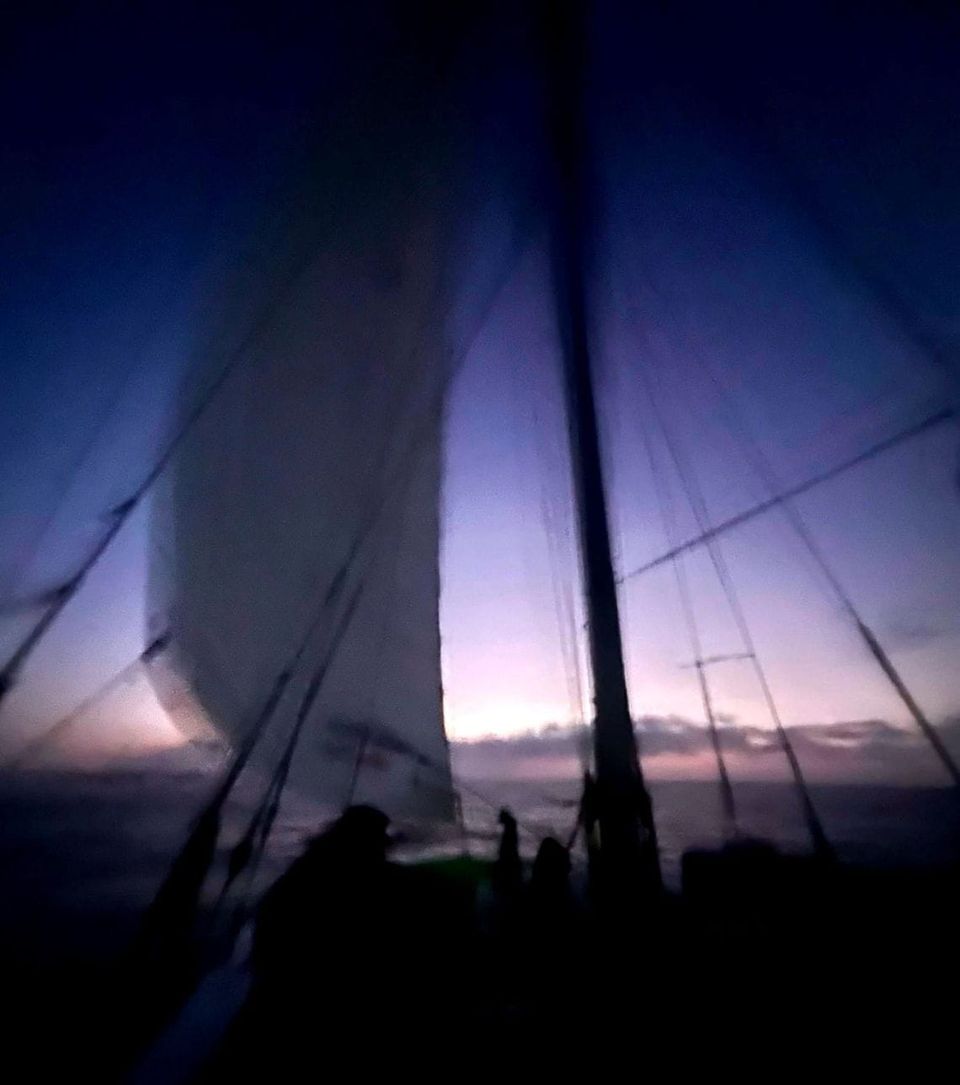
 Wind Voyagers of Changbin
Original version in Chinese
✐ Isin (Guanyuu) ✐
“Woah-ha-ha!” “I’ve got to show Isin this; he’s going to be so happy!”
Emerging from a half-asleep haze, I heard my name called, followed by an unmistakable air of joy drifting from the deck. It wasn’t yet time for my watch, but I opened my eyes anyway. The night was milder; the swells were low, and only a fine mist of spray had reached the cabin. It was just after 9:00 PM when I unzipped the cabin cover and climbed onto the deck, still heavy with sleep.
In the pitch-black night, everyone was lying on the platform, gazing upward. The white, red, and green navigation lights had all been turned off. The entire ocean sky was full—utterly, breathtakingly full—of stars.
This was the third night after the storm at Miyakojima. Alingano Maisu was crossing the Miyako Strait, making steady headway toward Okinawa.
Kazu was on watch with the steersman, verifying our heading by the compass. She spoke in a mix of Satawal and English. “Very very straight,” “Inarak wele,” she said in rhythmic, intermittent pulses.
I looked up, and the night sky revealed its deepest self to me. With no clouds to obstruct the view, what is it you wish to see?
Jupiter was the brightest, flanked by two equally radiant stars standing side-by-side—the Gemini twins. Near Jupiter was Eliyol, now in its tubul Eliyol phase. It is currently the most recognizable constellation in the sky—three stars tightly aligned in a straight line, sitting right on the western horizon. Since late last year, Eliyol has been the focal point of my stargazing in Changbin, Taitung. Seeing it felt like reuniting with an old friend. Hello, Eliyol!
Through Eliyol, one can easily find Sirius, the brightest star in the sky, shimmering with a hint of blue. Tonight, however, it didn’t seem particularly prominent because there were simply too many other brilliant stars. To Western eyes, Sirius belongs to Canis Major; tonight, it truly did look like a dog—a short-legged dachshund, actually. Quite cute.
Uul was also near Eliyol, part of a “pizza” shape that hung so low it looked as though it might drop right into the sea. Mwaleger, a misty cluster of stars huddling together, was near Uul. It was still visible but sat very, very low—so low it seemed to touch the surface of the water.
Capella rises in the northeast and sets in the northwest. Once you identify it and look to the right, you can find the North Star. Moss came over and asked me, “Isin, have you found the North Star yet?” I pointed it out and mentioned that I could also see the Big Dipper hanging high above. I asked Moss if the two stars at the edge of the dipper’s bowl were Welo. Moss confirmed that they were indeed Welo. Then I asked him which star was Mailapaifang. He pointed to the one just off the North Star. Everything was visible—every single star I wanted to see was there, clear and bright on a cloudless sea with zero light pollution.
The North Star looked higher here than it does from Changbin, a reminder that our latitude was further north. Directly opposite the North Star is due south. Oh, how I’ve dreamed of seeing the Southern Cross at sea!
I stumbled across the obstacles on deck to reach the other side of the canoe, searching for that cross-shaped constellation. The Southern Cross isn’t particularly bright; I searched the horizon intensely but couldn’t find it at first.
Arcturus and Spica were near the bow. Arcturus is the star Hōkūleʻa in Hawaii, and Spica is Hikianalia. The midpoint between these two is roughly due east. Where was the bow pointing now? With the North Star directly to our port side, we should have been heading toward tan Mailap (East), though we occasionally drifted toward Paiyor. I checked our direction with the steering crew, and sure enough, we were at tan Paiyor. The steersman was using the high-hanging Arcturus and the mast shrouds to lock in the heading. By observing multiple stars and gathering various signs, one can confirm and calibrate the course with much greater certainty.
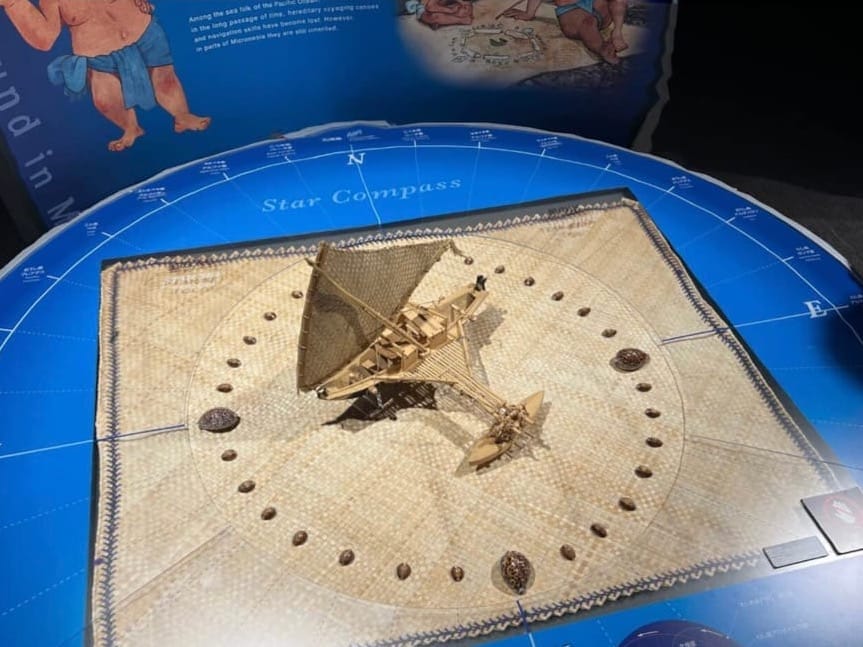
Finally, I have reached a point where I can discuss star names entirely in Carolinian and English. What I’ve learned can be applied directly aboard the Alingano Maisu, allowing me to work and deliberate with people from all over the world. Throughout my journey of learning the stars, I prioritized Carolinian names (such as Satawal and Lamotrek) alongside their English counterparts. Before I knew it, it became second nature.
These star names carry profound cultural weight. In Carolinian languages, the name of a star is synonymous with a direction. You can truly feel that they are a seafaring people; the sky is their compass, capable of guiding them across the globe. In contrast, Western star names often evoke an entire mythology of warfare, conquest, and revenge.
I am glad that I don’t have to memorize Chinese star names, thus avoiding the imperial and autocratic ideologies they often carry.
These matters regarding the stars are not for my learning alone; they are to be taught to others and passed down to the next generation. In my role as an educator, I strive to act with reflection and self-awareness, thinking deeply about what I truly want to impart.
At midnight, it was time for my watch. I went to the aft end of the starboard cabin to scout the distance. Wait... those three stars look a bit like... though the one at the base was missing (perhaps obscured by clouds?), two bright stars appeared side-by-side to its left, their alignment pointing toward the top of the trio.
That was the Southern Cross! Despite the missing star, the orientation of the neighboring stars confirmed it. However, in the eyes of the Carolinian people, these four stars do not form a cross; they are a fish—the Diamond Fish.
Translation post-edited by Yulun Huang (Yaya)